From Kore to Queen: A Personal Journey with Persephone
“I think it has always been inside me. The myth of Persephone and Demeter. I think I was born with it pre-existing in the underbelly of my subconscious; an archetypal template, waiting to spring into life, fully formed, through its seasons.
I never know when, except I’m always at a crossroads, struggling with a situation or a project: wrestling with myself for answers.
Until there, on the battlefield, the emotional fervour fires hot enough for the myth to appear. It somehow needs that heated charge to be born, to spring from the depths of my very own winter.”
— Vicky Yiannoutsos, from an emerging memoir
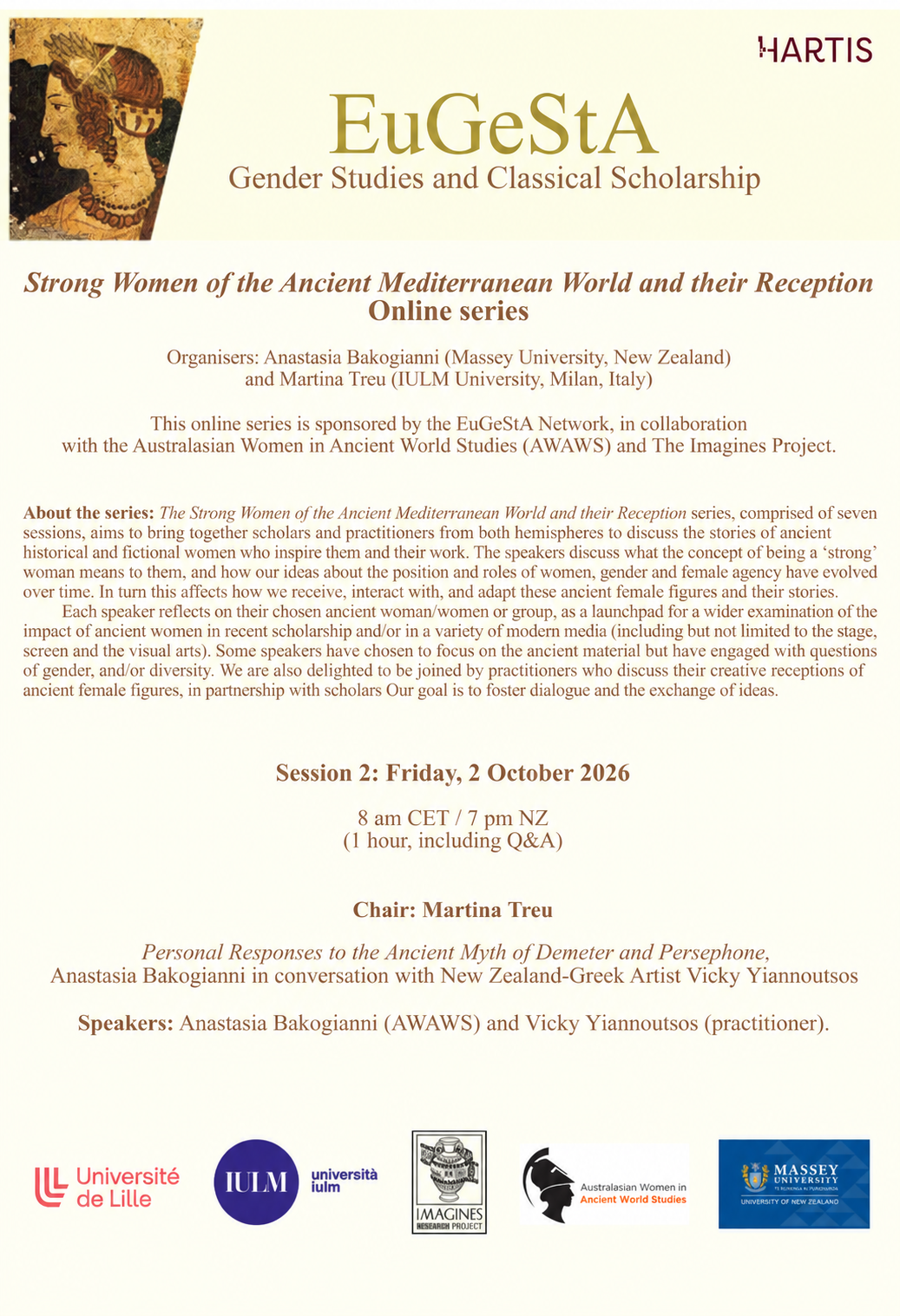
On Friday 2 October I’ll be joining classical scholar Dr Anastasia Bakogianni for an online conversation about my long and rather mysterious relationship with the ancient myth of Demeter and Persephone.
The first time it appeared, I was making Visible Passage, a documentary reuniting my father’s sister Antigone in New Zealand with her sister Olga in Greece after twenty years apart.
As filming progressed, I began struggling with the ethics of telling our family story. Did it have an audience beyond us? Could I use confidences that might make “good television”? The lines between filmmaker and family had blurred, and I became convinced I should give the funding back.
As the emotional pressure intensified, I descended deeper into the belly of the whale until — whoosh — there it was: the myth of the Two Goddesses as a metaphorical image system for migration.
The migrant leaves one world and enters another. Like Persephone, she eats the fruits of the new world and is changed by them. However deeply she may yearn for home, she can never return as the person who left.
Once I saw the universal within the personal, I could continue.
The myth was no longer only about my family, or even migration. We all cross thresholds into unknown territories and emerge changed.
In 2010, Persephone’s Plight: The Four Seasons of Migration took the mythology beyond the screen and into a spatial installation.
Then, at Eleusis in 2018, the question changed.
I became less interested in Persephone solely as the abducted daughter — the Kore — and increasingly fascinated by what might have happened to her in the Underworld.
What transformed Kore into Queen?
That question took me back to Greece and the ancient Mazarakata tombs on Kefalonia. In 2019, Persephone’s Return emerged there: a duologue between Demeter and the daughter who returns to her no longer a child, but a Queen.
Since then the work has continued to reveal itself through readings and performance — including my own unexpected discovery, when I finally inhabited Demeter, of the rage beneath her grief.
And now another threshold is appearing.
Persephone’s Return is growing beyond the duologue into a larger, evolving body of work — through performance, film, music, site-responsive installation and emerging spatial, sensory and digital forms — following the questions the myth presents:
How might an audience experience the journey from Kore to Queen? And how might contemporary forms bring us into renewed relationship with this ancient story?
On 2 October, Anastasia and I will follow the pathway that brought me here through conversation, film, images and excerpts from the work — and look to where the Two Goddesses might lead next.
About the event
Personal Responses to the Ancient Myth of Demeter and Persephone is part of the international online series Strong Women of the Ancient Mediterranean World and their Reception, sponsored by the EuGeStA Network, in collaboration with Australasian Women in Ancient World Studies (AWAWS) and The Imagines Project.
The series is organised by Dr Anastasia Bakogianni (Massey University, New Zealand) and Martina Treu (IULM University, Milan), who will chair the session.
Friday 2 October 2026 | Online via Zoom - contact me if you would like to attend